

Buttons
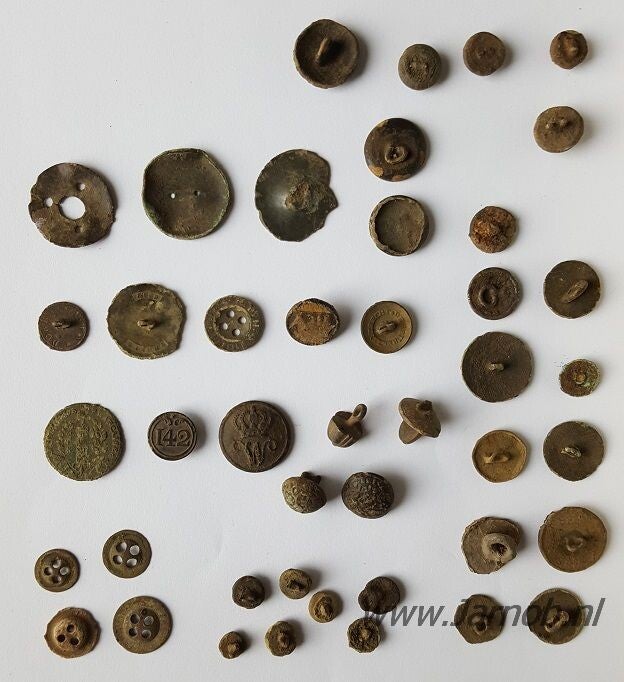


Buttons can be found in all different kind of types, sizes and era's. Above are shown very varied buttons: Napoleon buttons (1800), silver buttons, modern buttons (19th/20th century), 17th century type buttons. Fashion during the centuries changed much, buttons were an important part of clothing. Synthetic buttons were only invented since the 20th century, so practically all ages can be found by metal detector!




The PAN website has e very detailed determination chart for buttons - as well as all other possible findings. Very old itmes can be added to the site and an archaaologist will determine its exact date!
Above some very interesting buttons: top left a 'W' marked button, referring to king Willem I/ II/ III or queen Wilhelmina - all of the Netherlands. These buttons were worn by all Dutch government officials; ranging from military/ police all the way to the simple postman!
Next to it is a chinese button, depicting a cart with people pulled by a chinese man. These were buttons originally created in China for the Chinese market but exported in great numbers to Holland around 1800 during a (button) material shortage.
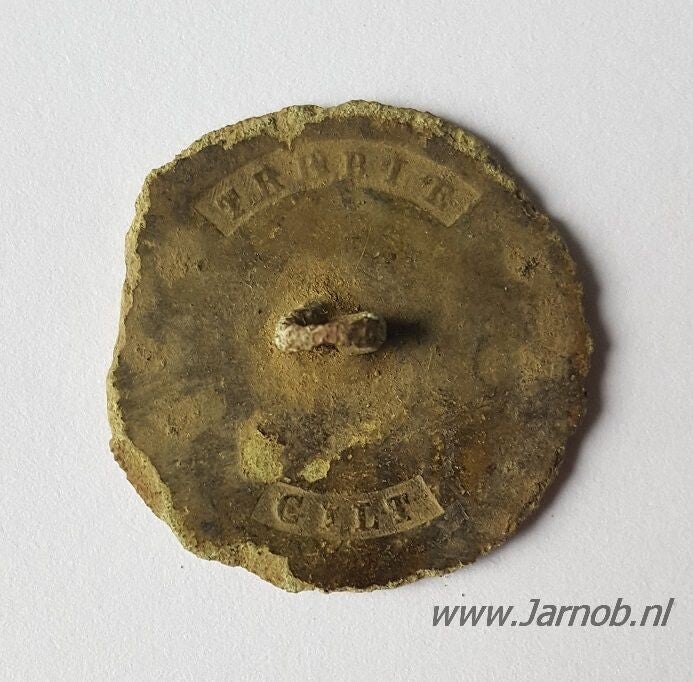
Next two flat buttons, one inscripted with 'DORE' 'BI' which is the French marking for gold (plated) with makers mark 'BI'. The other button is marked 'TRIPLE' 'GILT' which is the British counterpart for a gold (plated) button. Both are 19th century buttons.
The first button on the second row is clearly an older type (16th/ 17th century) of button, judging by its color, its design and rod type shank.
Next in line is an unknown button; it looks like an unfinished half-fabricated button, the hole in its shank is missing. Although the shank is rather big - the (forging?) markings on top of the button are also unclear. Maybe it is an experimental or try-out button.
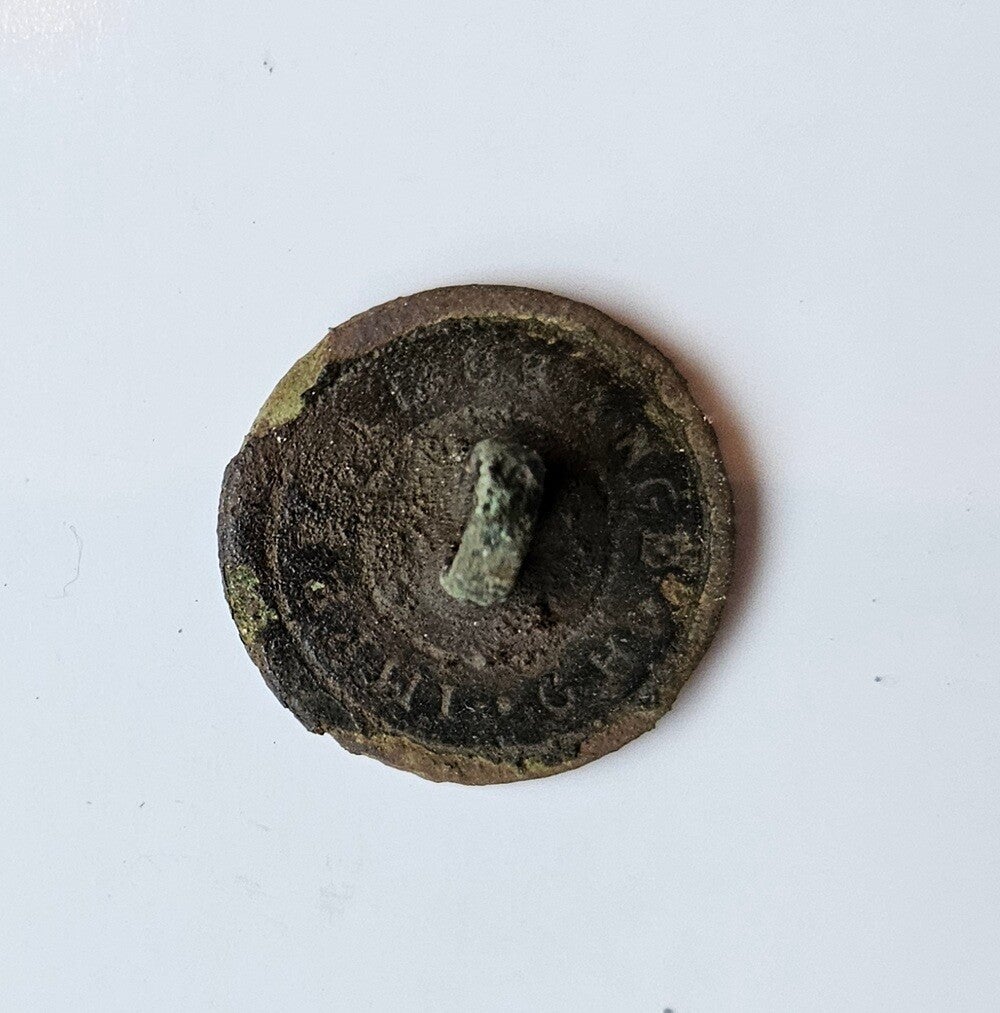
The final button is a gilded (stil visible traces) Dutch military button with two (very worn) crossed artillery canons on the front side. The back side is inscripted 'DE HEUS en ZN - UTRECHT' - 19th century.


Three different kind of button models - there is a huge collection of many different ancient buttons. The top left are a mixture of sphere/ half-sphere buttons with loop shanks; these were crafted since the 13th century. The second set are flat and shaped buttons with ring shanks, 17th/ 18th century. The set below have straight rod shanks, produced since the 15th century. Many variations exist and some are difficult to seperately identify while centuries of aging could be between them.


Below a set of buttons, Dutch 17th century, decorated with a well known weave pattern; to the right a photograph as an example of an undamaged button with the same pattern (not my find).




Marked buttons, left to right: 'IMPERIAL ORANGE' - English, 'PARIS' - French, 'LONDON PLATED' - English and a fourth button which just is nicely adorned with a wreath but still has markings of gilt. All buttons are 19th century.

Two samples of larger decorative buttons, both are hammered/ stamped with nice markings. The button to the right top has traces of colouring.


Another large decorative button, also known by the British as 'Dandy Button' - worn by men of a particular social status. Traces of gilting can be seen on the front side - it seems the centre has a part missing. The button to the left above is very damaged/ worn and could have been much larger, traces of circular placed dots can be seen on the front side and attachment of a (missing) shank on the back side.


Two more modern, but stil very interesting 19th/ early 20th century buttons. The left button has an anchor depicted on the front side with the marking 'LOODSWEZEN' which stands for the Dutch organization which guids vessels through risky waters.
The two 4 holes buttons are marked 'HPH' (other markings too much worn) and 'V. BOOGERYEN ROTTERDAM' which has clear visible traces of gilting in its letters.


Always a nice find and more rare are (pure) silver crafted buttons. The two small silver buttons, with loop shank, were produced from the 13th century (late middle ages), one of them is badly damaged. All buttons are hollow and have a tiny hole at the backside.
The larger silver button is a so called 'keelknoop' (neck button) which came in pairs and were used to close the shirt up at the neck side. These were used by persons of high status - especially the silver buttons. A small maker mark can be seen which is unfortunately too much worn for correct identification.


Non-metal old buttons can also be found by sight. Really old buttons, not made of a synthetic substance, could be made of horns, bone material or shells - like the ones found in the pictures.

Napoleonic Wars soldiers uniform buttons


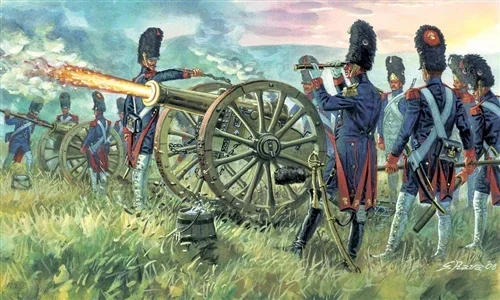


Military buttons are nice finds and due to their markings easy to identify. Holland, as well as other mainland European countries, was occupied during the early 19th century (1800-1815) by the French Republican/ Napoleonic armies. Traces of the French occupants and their battles can still be found.
General, more commonly, Republique Francaise buttons can be seen above - many models existed. Regimental buttons, like the 64 and I42 marked buttons can be found also. The smaller buttons were used on the front side of the soldiers uniform while the larger ones were used on the back side. Each soldiers uniform held dozens of buttons - obviously these were eays to loose! The 42nd Regiment is also marked with an 'I', which stands for Infantry.
The main artillery Republique Francaise button and the Naval Artillery 39th Regiment button are more rare.

